# MCP Gateway
Connect downstream MCP servers and let your approval pipeline decide every call through them.
Credentials stored on an agent's machine can give it a way around approval. If the agent can read an API key from an environment variable or configuration file, it can use `curl` or a script to call the service directly. Approval checks on its MCP tools do not protect that direct route.
The MCP Gateway is part of the hosted edition. The open edition has no gateway: its agents call their MCP servers directly and withHuman sees those calls through the agent's hooks alone.
The MCP Gateway keeps the external service's credentials in withHuman, separate from the agent's environment. The agent connects to the gateway using its own withHuman credential. You choose which tools it can use. Every call it makes goes through your [approval pipeline](/docs/web-app/approval-pipelines), which decides whether the gateway forwards it to the external MCP server, holds it for a person, or refuses it.
```mermaid
flowchart TD
subgraph protected["Through the gateway"]
direction TB
agent["Agent's machine
withHuman credential"]
gateway["withHuman gateway
Service credentials
Approval pipeline"]
second["External MCP server"]
agent -->|Tool call| gateway
gateway -->|Permitted call| second
end
subgraph direct["Direct connection"]
direction TB
local["Agent's machine
Service credentials"]
first["External MCP server"]
local -->|MCP tool or curl| first
end
```
This separation matters: keep the service's credentials and other ways to perform the same action out of the agent's reach, so it must use the gateway for those actions.
## Servers
The **Gateway** page lists your organization's registered MCP servers. Search by name or slug, and use **Live**, **Archived** or **All** to narrow the list. Live includes inactive servers; the active revision and credential status show whether a server is ready for use.
Each server has a display name, a permanent **Slug** and a **URL**. The slug becomes part of the tool names agents see. Several agents can share a server while having different tool access.
A newly registered server is inactive. Its connection, credentials and agent access can be prepared before activation makes it available to agents.
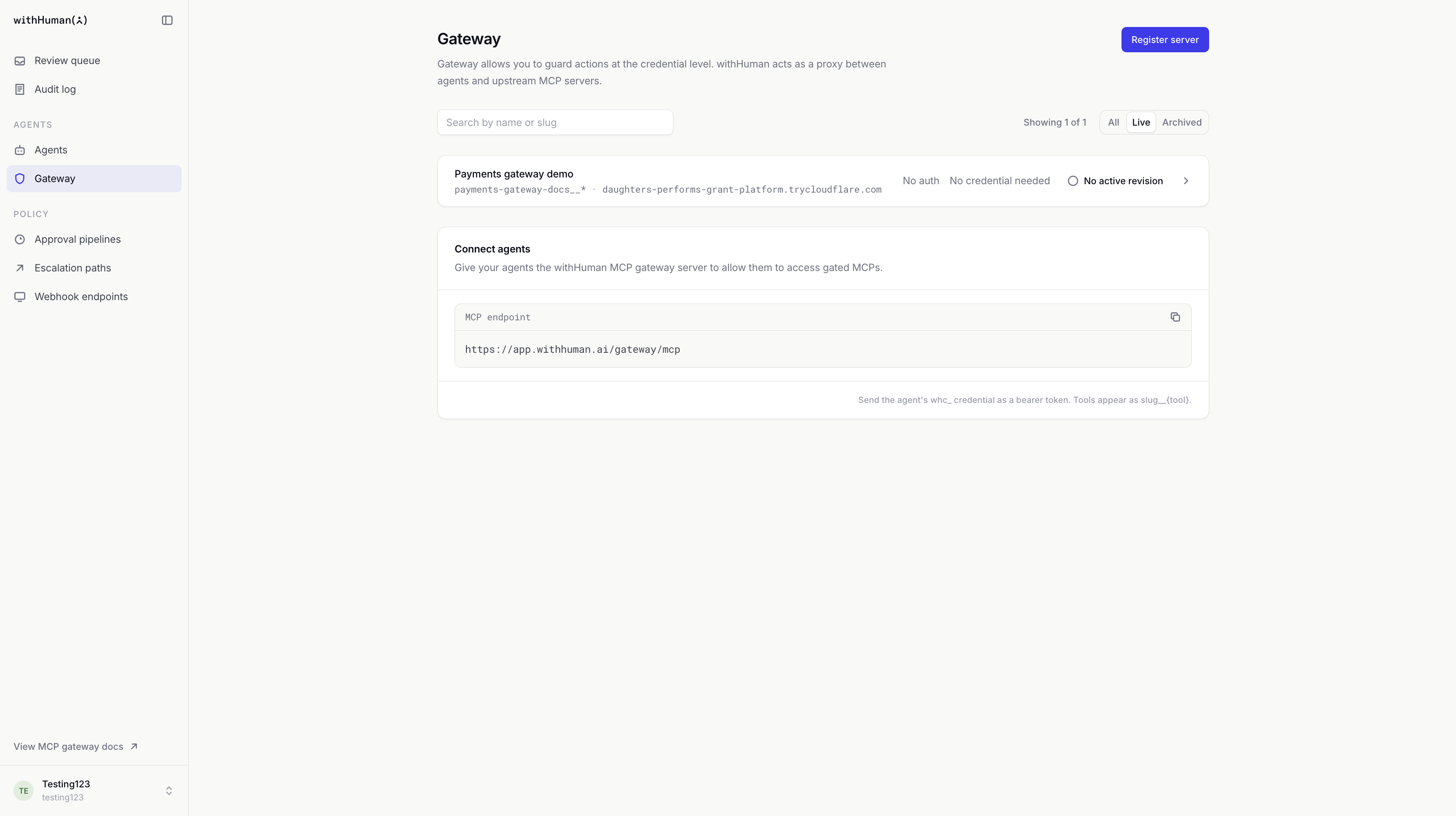
The inventory brings server status and the gateway's agent connection address together.
## Connections and credentials
The server URL must be a remote MCP endpoint supporting **Streamable HTTP**, reachable from your withHuman deployment. A local command that starts an MCP server is not a server URL.
**Authentication mode** describes how withHuman connects to that server:
| Mode | What it provides |
| --- | --- |
| **Static headers** | Saved headers, such as an `Authorization` header, accompany connections to the service. Their values are not shown again after saving. |
| **OAuth** | A connection authorized through the service's sign-in flow. Some services require a client ID, client secret or scopes. |
| **No auth** | A connection to a server that does not require credentials. |
Credentials belong to the server and are shared by its revisions and agent uses. Replacing headers or reconnecting OAuth changes that shared connection. Changing the URL, changing authentication mode or rolling back a revision does not restore an earlier credential.
**Disconnect** removes the credential stored by withHuman. It does not revoke the credential at the external service; revoke it there too when it should no longer work.
## Agent tool access
An agent's **Gateway Tools** determines which tools it can see and call on each server. Every instance of that agent inherits the same choices. Agents start with no access, and adding a server grants no tools until a selection is saved.
| Choice | Effect |
| --- | --- |
| **Selected tools** | Allows only the named tools you select. New tools are not added automatically. |
| **All tools, including future tools** | Allows every tool the server offers now and later. |
| **Remove server** | Removes this agent's access to the server. Other agents keep their own access. |
Access can be prepared while a server is inactive. Saving access changes the agent's next tool listing and calls, including calls still waiting for approval. Removing access blocks those waiting calls even if they are later approved. It cannot undo a call already sent to the external service.
## Approval
Tool access and approval answer different questions. Access decides whether an agent may use a tool at all. Your [approval pipeline](/docs/web-app/approval-pipelines) decides what happens to each allowed call. Nothing on the server page chooses which calls wait for a person: the gateway sends every allowed call to the pipeline.
```mermaid
flowchart TD
call["Agent calls a tool"] --> gateway["Gateway checks the agent's access"]
gateway -->|Tool not allowed| blocked["Call blocked"]
gateway -->|Allowed| pipeline["Approval pipeline"]
pipeline -->|Approved| server["External MCP server"]
pipeline -->|Denied or expired| blocked
```
The pipeline can approve or deny a call automatically, or send it to human review. An [escalation path](/docs/web-app/escalation-paths) selects reviewers when a person is needed. The tool call waits for the decision; a denial, expiry or failure to obtain a decision prevents it from reaching the server. With no pipeline block deciding a call, it waits for a person.
Write conditions with the server's own tool names, as the server's **Tools** listing shows them, without the gateway's slug prefix. Use the **MCP server** condition field to keep a rule to one server when two servers name a tool the same way. See [Conditions](/docs/web-app/conditions-blocks).
### Example: Refund access
For our **Payments gateway demo**, we'll allow `get_payment` and `refund_payment`, leaving `list_payments` unavailable. In the pipeline, a block that matches **MCP server** `payments-gateway-docs` and **Tool name** starting with `refund_` sends the call to a person, and a block for `get_payment` approves it.
Reading one payment then proceeds without waiting. A refund waits for a reviewer. Listing all payments stays unavailable, regardless of whether someone would approve it.
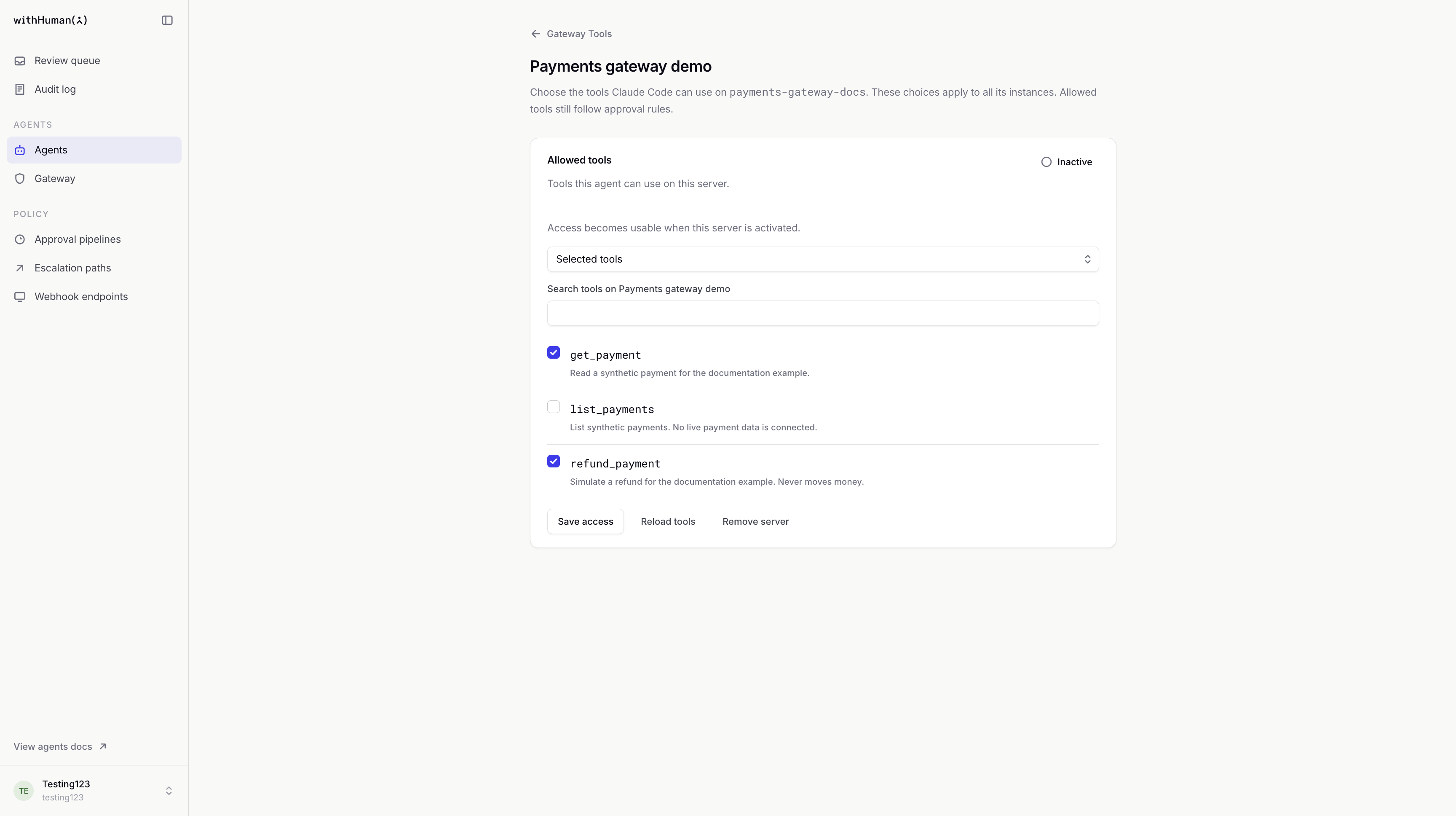
Tool access belongs to the agent. These example choices are unsaved, and the demonstration server is inactive.
## Drafts and activation
A **revision** records the server's name, URL and authentication mode. Saving a draft preserves proposed changes without affecting the active configuration. **Make active** makes a saved revision available to agents that have tool access.
**Revisions** keeps the saved history. Activating an earlier revision rolls back those settings. Credentials and agent tool access are managed separately, so neither is rolled back with the revision.
A waiting call is not guaranteed to use the old connection. Before forwarding an approved call, the gateway checks current access and uses the server's current active connection. Deactivating the server or removing the agent's access can still block it.
## Agent connections
On hosted withHuman the `withhuman` CLI connects your agents for you. Guided setup and `withhuman agent install` register the gateway with every runtime they connect, as an MCP server named `withhuman` that the CLI itself runs. That local server forwards the runtime's tool calls to the gateway with the instance's own credential, which stays in the CLI's private credential store rather than in the runtime's configuration. Claude Code, Codex, Hermes and OpenClaw are configured automatically. Restart the runtime after installation so it starts the new server. DeepSeek Harness shows a snippet to add to its profile, and Pi has no MCP client.
Inside the runtime, gateway tools carry the `withhuman` server name before the gateway's own naming. Our example's refund tool appears to Claude Code as `mcp__withhuman__payments-gateway-docs__refund_payment`. `withhuman agent eject` removes the server again.
Other MCP clients connect to the endpoint shown in **Connect agents** themselves, with the agent's [instance credential](/docs/web-app/agents#api-key-setup).
| Setting | Value |
| --- | --- |
| Transport | Streamable HTTP |
| MCP endpoint | The address shown in Connect agents. On hosted withHuman: `https://app.withhuman.ai/gateway/mcp` |
| Authorization header | `Authorization: Bearer ` |
The instance credential starts with `whc_`. Use a separate credential for each instance; personal and organization API keys are not gateway agent credentials.
Agents see only their allowed tools on active servers. Names use `__` so tools from different servers remain distinct. Our example's refund tool appears as `payments-gateway-docs__refund_payment` on a direct connection.
The gateway currently forwards **tools** only. MCP resources, prompts, sampling and elicitation are not supported.
## Activity and connection problems
**Tools** discovery checks that withHuman can reach the server and read its tool list using the saved credential. It can work before activation. It does not call a tool, check an agent's access or test a pipeline decision.
A controlled call from a connected agent checks the full route. Calls that wait for a person appear in the [Review queue](/docs/web-app/review-queue). Automatic decisions do not wait there. Every call through the gateway is an approval request, so the request list shows its decision, and the [Audit log](/docs/web-app/audit-log) records the call's outcome with the agent instance and its request. See [Gateway activity](/docs/web-app/audit-event-types#gateway-activity) for the event details.
A forwarded call has been sent to the server; that does not prove the external action succeeded. Check the tool's response too.
| What you see | What it means |
| --- | --- |
| No tools appear for the agent. | Check the server's active revision, the agent's saved tool access and its instance credential. |
| **Discovery unavailable** or a connection failure | Check the MCP URL, service availability and stored credentials. Saved tool selections remain in place. |
| A selected tool is **Not advertised** | The server no longer lists that tool. Refresh discovery or remove the old selection. |
| A call is blocked after approval. | Access or server status may have changed while it waited. Approval does not restore removed access. |
| The gateway endpoint is missing or unavailable. | Ask the deployment administrator to check that the gateway is configured and reachable. |
## Deactivation and archiving
Deactivation pauses a server without deleting its configuration or credentials. A saved revision can be activated again later.
**Archive server** is permanent. It stops access, removes stored credentials and preserves the server's history. The slug stays reserved. Use deactivation when you expect to bring the server back.
## Permissions
Viewing gateway servers and managing them require different permissions. Management covers configuration, credentials, activation and archiving. Viewing or changing an agent's tool access also requires permission to read that agent. Archived agents and servers are read-only.
Gateway management does not grant permission to decide approval requests. See [Permissions](/docs/web-app/permissions) for access policies and scopes.